

Designing the Table around Connection
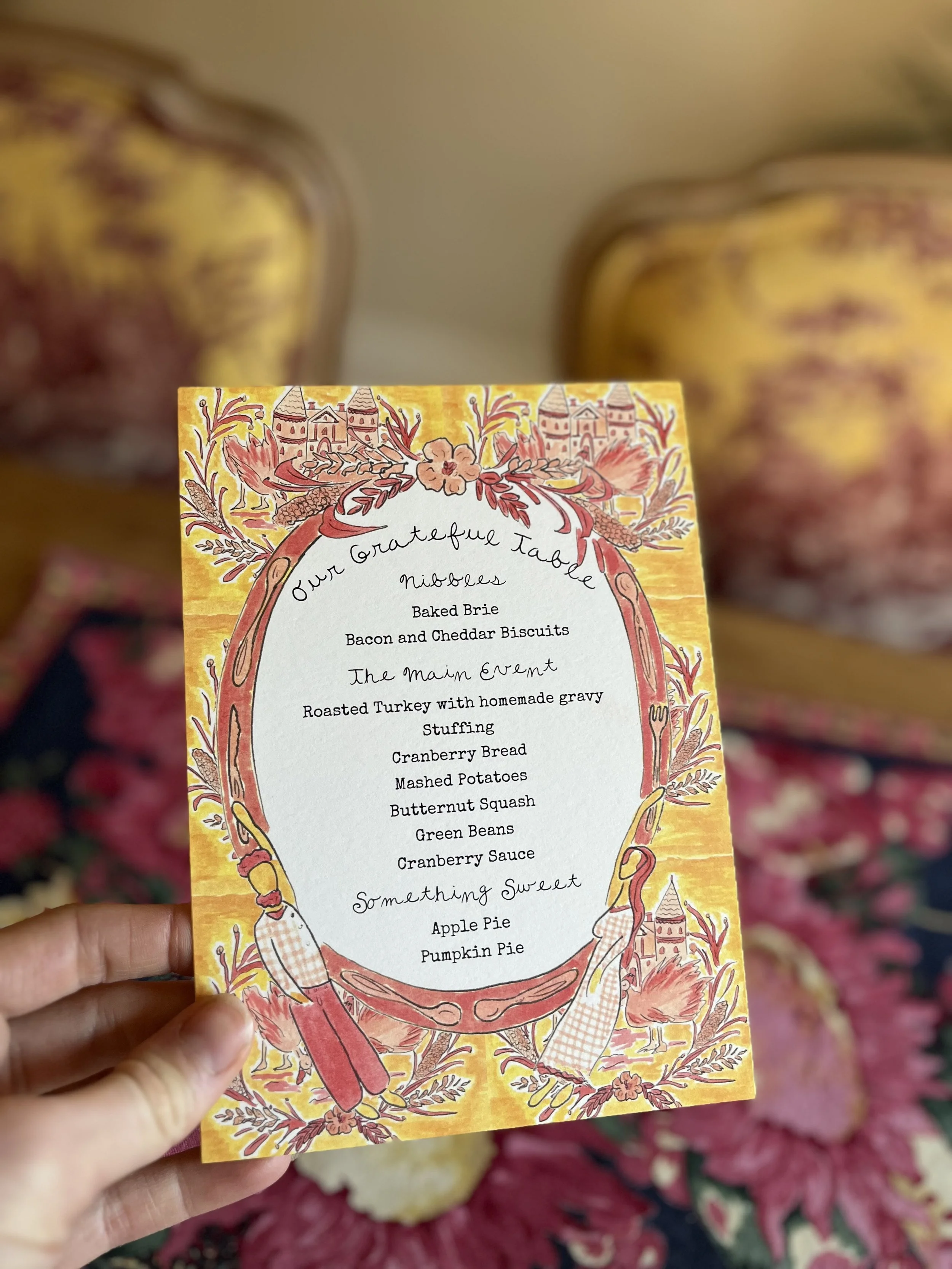
For the first time in our new home, my husband and I are hosting Thanksgiving - bringing together our two families under our new roof. Naturally, I decided to design a menu for our table, inspired by the toile patterned dining chairs (originally upholstered by my husband’s mom!) that we’ll be sitting at. But it didn’t end there.
Because I didn’t want to design a menu just to design a menu. I wanted it to serve a purpose that went beyond a pretty piece of paper. I wanted it to help tie the different members of our family together at the table - to make people feel seen and special, and perhaps start a new tradition in this new space, centered around the Thanksgiving theme of gratitude. And so, I decided to use the back of our beautifully designed menus as pre-printed place cards with each guest’s name, with enough space below for us to write a hand-written note to each guest, expressing our gratitude to them. A pretty piece of paper that might otherwise get thrown away is immediately transformed into something to be treasured and saved.
And I share this because, whether or not you work with me on your wedding stationery, I want to invite you to bring this same kind of thinking into your wedding table, or even your next dinner party. I want you to consider how you can use your stationery not just to convey information and offer beauty (although those things are important, too!) but also to bring your guests together in these increasingly divided times. I want you to consider how you can design your table around the theme of connection.
There are so many ways you can do this - some I’ve explored with past clients, some I’ve seen online and just love. I invite you to steal any and all of these!
Hand-written notes to each guest serving as place cards
A story on the back page of the menu sharing how the couple met
Polaroid photos of each guest serving as a place card
Cocktail napkins with an inscription of the first text message shared between a couple
Conversation topics written onto every table number based on where you seat people
You get the idea! While there is no need to go overboard here, I highly recommend thinking about how you can weave in a little more intention and a little more connection into your next event. I promise you’ll thank me later.
The Role of Imperfection in Artwork
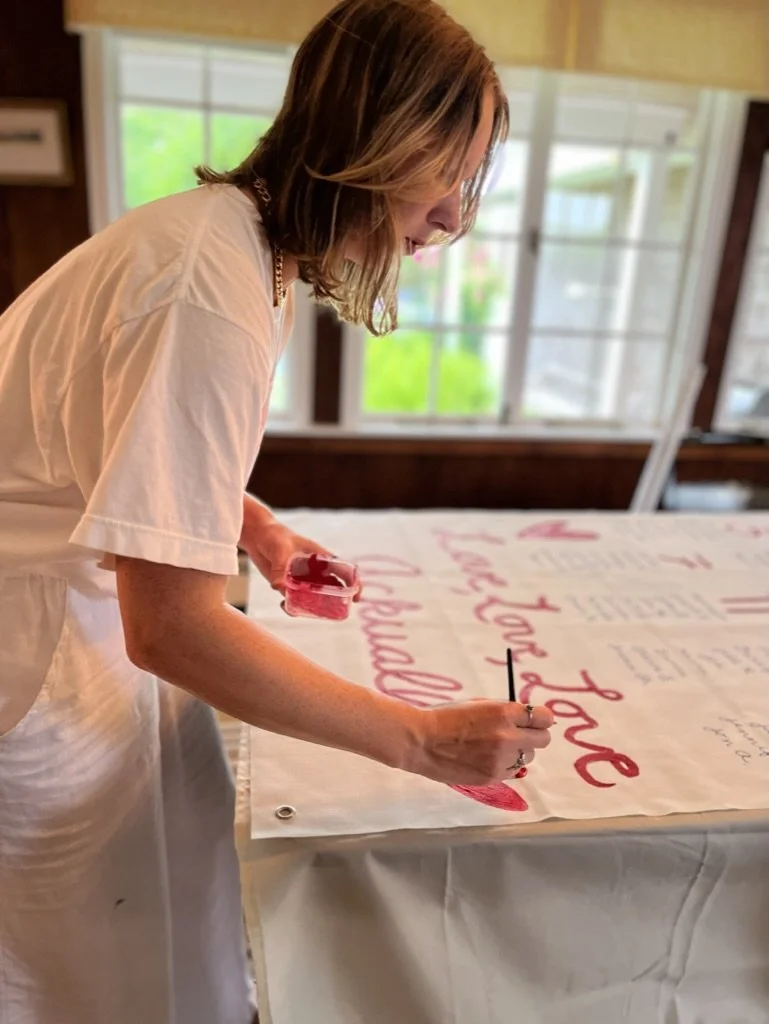
I recently worked on a wedding where I created a number of hand-painted, original items for the weekend’s events. While all of my work starts out hand-painted, typically I then scan the designs, edit them, and get them printed for stationery. But these pieces - tambourines and maracas, a big draping escort display sign, and tablecloths for the rehearsal dinner - were all getting painted by hand, with my raw, original, unedited artwork on display. Rather than having the manicured and printed version, this client actually wanted and invited the bold, hand-done detail as the knew it would stand out to her guests. Pops of red, bold drapery of paint would naturally take the stage aside the monotony of typical, clean typeface. And I found myself thinking about the role of imperfection in my work as I hand-painted this escort display.
As I paitned each number above the guest names for each corresponding table, I found myself not only embracing, but even slightly striving for imperfection - making the “1” a little slanted here, a little taller there, adding a whimsical curvature to the tail of a “5".” Making the whole thing more playful, more human, more alive. Because, I thought to myself, if this client specifically wants this to be painted by hand, with a literal human touch, that should come across. And, as we know, our humanness is anything but perfect. And so, an asymmetry here or a juxtaposition there - rather than perfect alignment and carbon copied creations - became not just a mistake I was making and then accepting, but actually something I was going for. Because, after all this work and all this time, I wanted people to know - this was made by a person, not a machine. And it’s actually so much more beautiful and interesting that way.
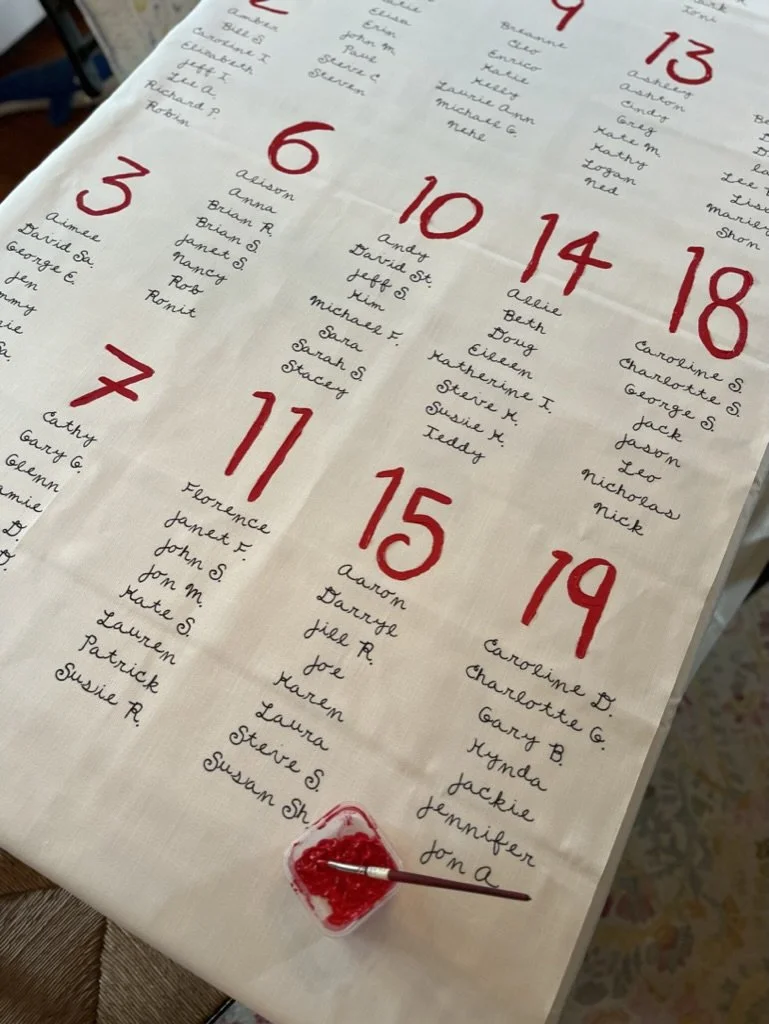
Was I expecting to have such profound revelations while merely painting some numerics onto a linen cloth? No. But I think it is valuable food for thought, especially as we enter into the age of AI. So much of art is often valued by its technique, its precision, how accurately it represents a subject, and how * perfect * it is. But as automated creation takes over, I think the messy, the imperfect, the human will become all the more sought after. All the more interesting, all the more beautiful. And, as an artist whose technique is anything but perfect, but who puts so much heart and creativity and humanness into my work, I am excited to be a part of this evolution. Where the personal, imperfect human touch reigns supreme.
And so I invite you to think about this as you plan your own wedding (or relationship or life). What if, instead of merely accepting imperfection but secretly shunning it, what if you actually sought it out sometimes? As a sign of being real, being human - as a sign of life? Because, I believe that is what these events are all about, really. Not a display of perfection but rather a celebration of love - one of the most perfectly imperfect things we have.